July 2024 By Ramona Cornell du Houx The University of Maine (UMaine) has been selected to receive $12.5 million through the U.S. Department of Energy’s Advanced Research Projects Agency-Energy (ARPA-E) to advance the research and development of its VolturnUS + floating offshore wind turbine (FOWT) technology. This funding, which was competed under the ARPA-E ATLANTIS program, will enable UMaine to […]
July 2024
By Ramona Cornell du Houx
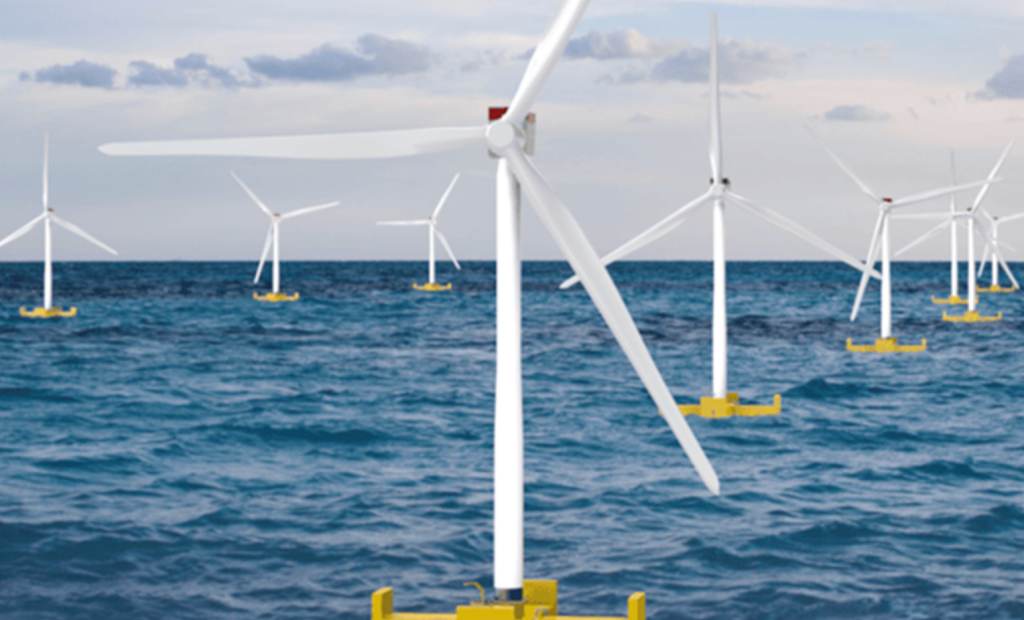
The University of Maine (UMaine) has been selected to receive $12.5 million through the U.S. Department of Energy’s Advanced Research Projects Agency-Energy (ARPA-E) to advance the research and development of its VolturnUS + floating offshore wind turbine (FOWT) technology.
This funding, which was competed under the ARPA-E ATLANTIS program, will enable UMaine to continue innovating in the field of floating offshore wind turbines with goals of further reducing costs through innovation and accelerating industrialization.
According to the US DOE Website: “ATLANTIS ((Aerodynamic Turbines Lighter and Afloat with Nautical Technologies and Integrated Servo-control) projects will aim to develop new and potentially disruptive innovations in FOWT technology to enable a greater market share of offshore wind energy, ultimately strengthening and diversifying the array of domestic energy sources available to Americans.”
About two-thirds of the US offshore wind energy is in deep waters, more than 150 ft deep, requiring the use of floating wind turbines. Floating turbines can be fabricated and assembled onshore or nearshore like vessels and towed out to sea and moored far from shore.
The Biden Administration declared floating wind as a US Energy EarthShot: “The climate crisis calls for a different kind of moonshot. Energy Earthshots™ will accelerate breakthroughs of more abundant, affordable, and reliable clean energy solutions within the decade. They will drive the major innovation breakthroughs that we know we must achieve to solve the climate crisis, reach our 2050 net-zero carbon goals, and create the jobs of the new clean energy economy. The Energy Earthshots target the remaining solution points of the most challenging technical problems across our energy economy.”
The Gulf of Maine has nearly 156 GW of offshore wind capacity within 50 miles, and harnessing 3 percent of that resource is enough to electrify heating and transportation in Maine.
The new VolturnUS + technology builds upon UMaine’s proven VolturnUS semi-submersible concrete hull technology and includes new features such as motion mitigation technology that reduces wave and wind-induced motions, and helps keep the turbine within acceleration and inclination limits in extreme storms.
The patented motion-mitigation technology leads to even smaller, lighter and simpler hulls to build. These hulls can be built using precast-concrete modules or slip-forming, and can be assembled in a port facility. These lighter, corrosion-resistant concrete hulls can also be efficiently produced locally, and result in lower operations and maintenance costs.
Nearly one year ago, Governor Janet Mills signed into law LD 1895, legislation to advance offshore wind in Maine by procuring up to 3,000 MW of offshore wind energy, enough to power 1.3 million homes, allows for critical port development, creates opportunity for all Maine workers and businesses in the emerging offshore wind industry, and protects critical lobstering areas from development.
The ATLANTIS (Aerodynamic Turbines Lighter and Afloat with Nautical Technologies and Integrated Servo-control) program aims to develop innovative FOWTs that are lighter and more efficient, using advanced design tools and real-world data.
The program seeks to boost energy security, reduce environmental impact by cutting fossil fuel reliance, and lower the cost of wind energy production, making it more accessible near major U.S. coastal cities.
UMaine’s success in the ATLANTIS program national competition helps keep Maine in a technology leadership role in this key renewable energy space, supports Maine’s offshore wind roadmap, and adds to UMaine’s track record of national and international leadership in floating offshore wind research and development.
The U.S. Department of Energy (DOE) and Department of the Interior (DOI) released a National Offshore Wind Strategy document in September 2016 which indicates that 80 percent of U.S. electricity demands are located in coastal states and that the total U.S. offshore wind energy potential is more than twice what the entire country currently uses. Nearly 80% of the U.S. offshore wind resource is located in deepwater.
Since proven through the New England Aqua Ventus I demonstration project, the University of Maine’s VolturnUS technology could be used to harness the deepwater offshore wind resource within the United States.
In 2021, with bipartisan support the Maine Legislature passed LD 336, “An Act to Encourage Research to Support the Maine Offshore Wind Industry,” which declared the research array in the public interest by and authorizes the Maine Public Utilities Commission to negotiate a contract for up to 144 MW of energy from the proposal proposed floating offshore wind research array in the Gulf of Maine.
The research array off the coast of Maine will allow the State, the fishing community, wildlife experts, and many others to learn about the potential impacts of floating offshore wind and inform commercial development that capitalizes on innovative technology and abundant resources while protecting our interests, industries, environment, and values.
Maine moved forward with the research lease application to maximize research opportunities at the site, which is a key component of the lease agreement between the State, the developer, and BOEM. The Maine Offshore Wind Research Consortium will play an important role in identifying research priorities for the State at the array. Broadly, the Consortium is tasked with creating a common understanding of the local and regional impacts – both positive and negative – of floating offshore wind in the Gulf of Maine and is led by a diverse advisory board with representatives from the fishing community, research institutions, environmental groups, and the offshore wind industry, among others.
On August 19, 2024, the State and BOEM reached an agreement on the research lease, a significant milestone in the development of offshore wind energy for Maine, which has the potential to deliver good jobs and economic development for the state and protect the environment and wildlife by reducing harmful emissions that contribute to climate change.
Maine Insights, a 501(c)4, connects our main streets with lawmakers in Augusta, highlighting state policies, technological innovations, agriculture, education, community growth and economics with factual analysis, individual profiles and exclusive in-depth coverage. We also report on areas where justice is not being served in the hope to be a contributing catalyst for change.
Your contribution today, will ensure our reporting continues into the future. Please send your donation to 8 Brook St., Solon, ME 04979.
Visit PEN for in-depth coverage of how America is addressing the climate crises. Systemic racism has held back progress, along with the deep pockets of industry that don’t want to change the status quo.
Protect Earth Newsmagazine highlights what lawmakers from the local level on up to the Federal Government are doing to protect the earth. We also report on community ingenuity and innovations that will help the U.S.A. transition to being powered by 100 percent, clean renewable energy. A 501(c)3 project of the Solon Center for Research and Publishing.
LATEST NEWS
SCIENCE MONDAY
Helpful science tips in playful videos that explain principles we all deal with to understand our climate crisis. The PENseries is the creation of Olivia Baaten.



 Maine Insights Newsmagazine