Listen to the story HERE By Kathryn Carley February 10, 2025 The Trump administration aims to increase domestic seafood production through industrial aquaculture but opponents said it puts Maine’s coastal communities at risk. Floating cages holding thousands of fish can harm native ecosystems by releasing pathogens and parasites into the ocean, harming the wild stocks on which local fisheries depend. George Kimbrell, […]
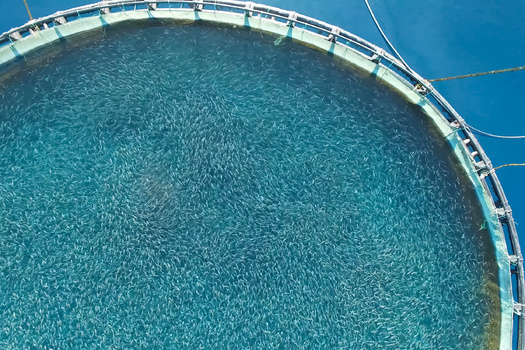
Farmed seafood products make up half of the world’s seafood supply, but U.S. production lags, leading to a $16.9 billion seafood deficit in the United States in 2020, according to NOAA. (Adobe Stock)
The Trump administration aims to increase domestic seafood production through industrial aquaculture but opponents said it puts Maine’s coastal communities at risk.
Floating cages holding thousands of fish can harm native ecosystems by releasing pathogens and parasites into the ocean, harming the wild stocks on which local fisheries depend.
George Kimbrell, legal director at the Center for Food Safety, said aquaculture permits could be fast-tracked as proposed during Trump’s first term.
“What we saw then and what we anticipate now is mirroring what the Trump administration has done in other areas, which is unfettered deregulation of industry,” Kimbrell observed.
Supporters of large-scale aquaculture said it can help meet the growing demand for seafood while easing pressure on depleted fisheries but Kimbrell countered wild forage stocks are being overharvested to ensure fish farms have enough fish food.
Small-scale aquaculture, including shellfish and marine plant farms, is boosting local Maine economies and creating jobs. Conservation groups argued large fin fish farms are similar to land-based concentrated animal feeding operations, or CAFOs, which create harmful amounts of waste and reduce jobs through automation.
Kimbrell explained the Trump administration wants more of them in federal waters.
“Establishing CAFOs of the sea is going to be very similar to what we’ve seen in Iowa and all across the U.S. in terms of its dramatic environmental impacts and its failure to provide an economic support for those communities,” Kimbrell contended. “Instead of farmers, it will be fishers that will be displaced.”
Kimbrell encouraged people to make informed decisions about their seafood and to support sustainably managed wild fisheries along with the nonprofits working to protect the ocean.
The National Oceanic and Atmospheric Administration has already identified so-called “aquaculture opportunity areas” starting in the Gulf of Mexico. Public comments on the permits are being accepted through Feb. 20.
Maine Insights, a 501(c)4, connects our main streets with lawmakers in Augusta, highlighting state policies, technological innovations, agriculture, education, community growth and economics with factual analysis, individual profiles and exclusive in-depth coverage. We also report on areas where justice is not being served in the hope to be a contributing catalyst for change.
Your contribution today, will ensure our reporting continues into the future. Please send your donation to 8 Brook St., Solon, ME 04979.
Visit PEN for in-depth coverage of how America is addressing the climate crises. Systemic racism has held back progress, along with the deep pockets of industry that don’t want to change the status quo.
Protect Earth Newsmagazine highlights what lawmakers from the local level on up to the Federal Government are doing to protect the earth. We also report on community ingenuity and innovations that will help the U.S.A. transition to being powered by 100 percent, clean renewable energy. A 501(c)3 project of the Solon Center for Research and Publishing.
LATEST NEWS
SCIENCE MONDAY
Helpful science tips in playful videos that explain principles we all deal with to understand our climate crisis. The PENseries is the creation of Olivia Baaten.



 Maine Insights Newsmagazine