Listen to the story HERE. By Kathryn Carley May 26, 2023 Environmental advocates say the U.S. Supreme Court has dealt a major blow to the Clean Water Act and to Maine’s ability to protect some of its most pristine wetlands. A 5-4 decision in Sackett v. EPA held wetlands can only be regulated under the Clean Water Act if they have a […]
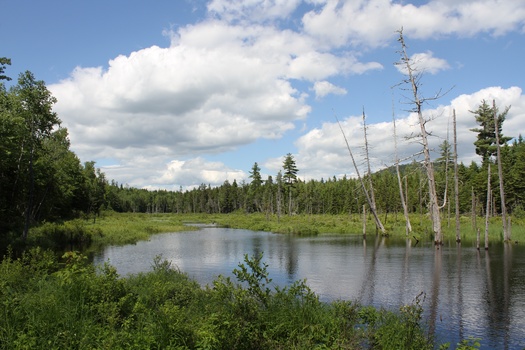
More than one-third of threatened and endangered species live only in wetlands, according to the EPA. In Maine, some of the threatened species found in wetlands include the Blanding’s Turtle, Ringed Boghaunter Dragonfly, and English Sundew. (Adobe Stock)
Environmental advocates say the U.S. Supreme Court has dealt a major blow to the Clean Water Act and to Maine’s ability to protect some of its most pristine wetlands.
A 5-4 decision in Sackett v. EPA held wetlands can only be regulated under the Clean Water Act if they have a “continuous surface connection” to larger, regulated bodies of water.
Alex Funk, director of water resources and senior counsel for the Theodore Roosevelt Conservation Partnership, said the ruling eliminates federal protections for nearly all wetlands in the country.
“Anyone that hunts, fishes, recreates or uses water, there was a big hit to that today from the court,” Funk asserted.
The high court ruled in favor of an Idaho couple who had been prevented from building a home near a lake federal officials identified as also containing wetland property and required a special permit. About one-fourth of Maine’s land area is wetlands, which is four times the wetland area of the other five New England states combined.
Maine’s coastal waters, rivers and lakes all depend on wetlands to filter out pollutants. Wetlands also serve as vital habitat for wildlife and flood protection for communities.
John Rumpler, clean water program director for Environment Maine, called today’s ruling a devastating blow to protecting the state’s waterways, and a misguided interpretation of the Clean Water Act.
“If a vast number of acres of remaining wetlands in Maine are no longer protected by our federal Clean Water Act, then there’s a risk that polluters and developers will run amok and put our water at risk,” Rumpler contended.
Rumpler stressed it is now up to state agencies and lawmakers in Augusta to ensure all of Maine’s waterways, especially its wetlands, are protected by state law. He argued Congress will eventually need to create greater federal protections for the nation’s vital water resources.
Maine Insights, a 501(c)4, connects our main streets with lawmakers in Augusta, highlighting state policies, technological innovations, agriculture, education, community growth and economics with factual analysis, individual profiles and exclusive in-depth coverage. We also report on areas where justice is not being served in the hope to be a contributing catalyst for change.
Your contribution today, will ensure our reporting continues into the future. Please send your donation to 8 Brook St., Solon, ME 04979.
Visit PEN for in-depth coverage of how America is addressing the climate crises. Systemic racism has held back progress, along with the deep pockets of industry that don’t want to change the status quo.
Protect Earth Newsmagazine highlights what lawmakers from the local level on up to the Federal Government are doing to protect the earth. We also report on community ingenuity and innovations that will help the U.S.A. transition to being powered by 100 percent, clean renewable energy. A 501(c)3 project of the Solon Center for Research and Publishing.
LATEST NEWS
SCIENCE MONDAY
Helpful science tips in playful videos that explain principles we all deal with to understand our climate crisis. The PENseries is the creation of Olivia Baaten.



 Maine Insights Newsmagazine